

Right to Hunt: Hidden Costs to Taxpayers of Special Interest Group Amendments.
Wasted Tax Dollars
Costly amendments often require significant new revenue streams, leading to higher property taxes and increased fees for essential public services.
Reduced Public Investment
When funds are diverted to special interest projects, the result is less money available for education, infrastructure, and public health initiatives that benefit all Coloradoans.
Excerpt from 302 (A83) Fiscal Impact Statement

Another Example
When TABOR's strict tax-limit rules collided with later school-funding mandates like Amendment 23, the Colorado Supreme Court repeatedly interpreted TABOR narrowly, so the newer amendment could function. That harmonization process effectively weakened TABOR's plain text by allowing revenue increases and mill-levy changes that would otherwise have required voter approval.


Heritage is Not Entitlement
Examples: Right to Hunt Lawsuits More Common Than Thought

Colorado’s Wildlife Will Lose Every Time — Just Like Florida’s Sea Turtles Did
Are you ready, Colorado?
Supporters of 83, Right to Hunt, are openly bragging about shutting down new protections for endangered sea turtles in Florida and they’re selling that outcome as a win and a model for Colorado.
On Marco Island, city leaders considered a simple, common‑sense rule: restricting overnight fishing during sea turtle nesting season. The goal was to reduce “false crawls,” when turtles come ashore but abandon nesting, incidents that officials say have risen 86%, often due to bright lights and crowds from midnight shark‑baiting groups on protected nesting beaches.
But the proposal never even got off the ground.
IOTR’s Travis Thompson points to Florida’s Amendment 2 — the same type of constitutional “right to hunt and fish” amendment as the reason the city backed down. He boasts that one angler, acting alone, used the amendment to kill the rule. No groups, no coalition, just a single individual empowered by a constitutional right that overrides local wildlife protections and the will of the people.
And now, he says Florida’s amendment is the blueprint for Colorado.
If Amendment 83 passes, Colorado residents, voters, and wildlife lose.
Local governments will face the same barriers Marco Island did. Even basic, science‑based protections for vulnerable species could be challenged and overturned by anyone claiming their “right to hunt or fish” is affected.
Florida’s experience isn’t a warning from opponents.
It’s a sales pitch from 83's own supporters.
While similar restrictions have been passed in places like Miami Beach, where shark fishing is banned, FWC says those rules may face similar legal challenges.
FWC also warned the proposed ordinance would not hold up legally, calling it "unenforceable and likely unconstitutional." That assessment ultimately led city leaders to reject the proposal.
Heritage is Not Entitlement
Examples: Right to Hunt Lawsuit Forces Disastrous Hunt
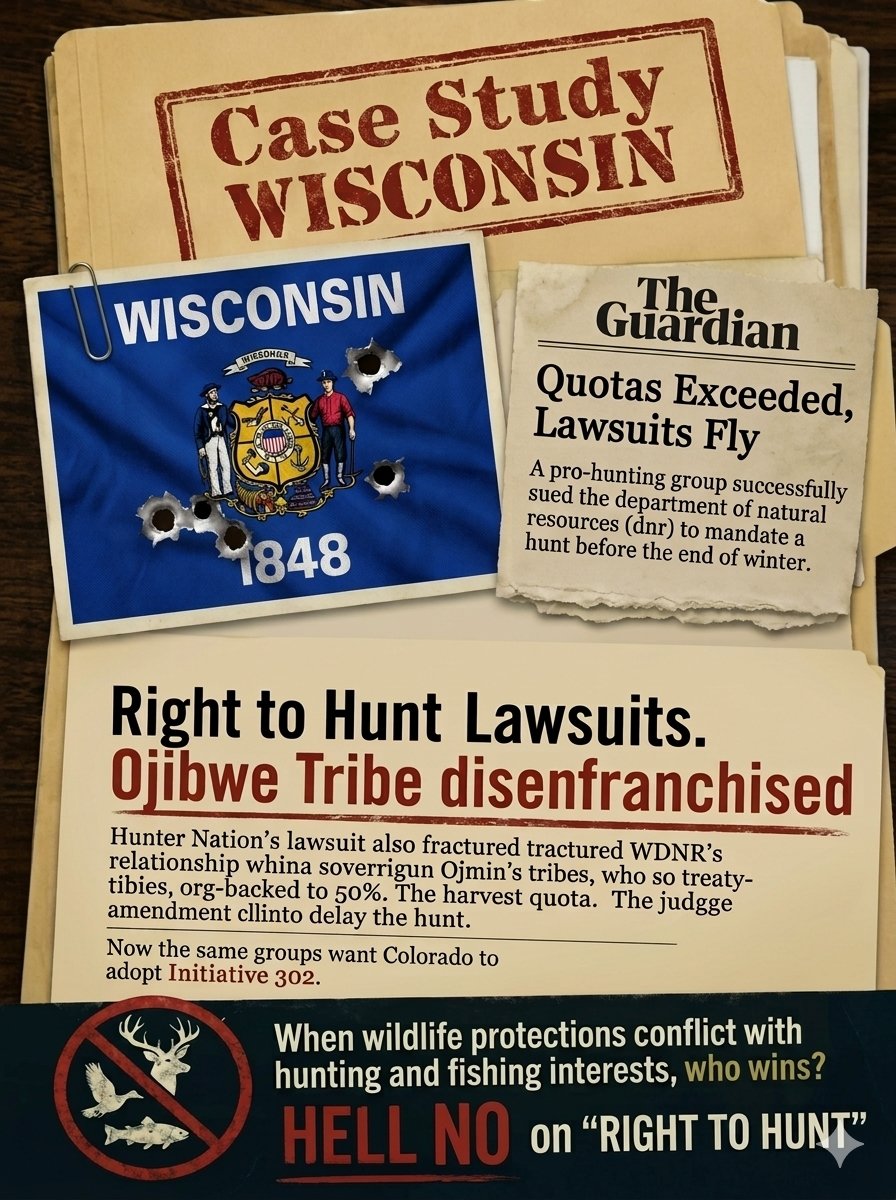
Hunter Nation sued WI Dept of natural resources: Devastates species population and fractures state's relationship with Ojibwe tribe
In Wisconsin, IOTR boasts using that state’s RTHF constitutional amendment in February 2021 to force the Wisconsin Department of Natural Resources (WDNR) to hold a hunt, overriding the agency’s wildlife professional’s high level of biological concern. This despite WDNR’s objections that the hunt would occur in the midst of the breeding season which could impact production of young.
Forced by the lawsuit filed by Hunter Nation — its then president, the current CEO of IOTR — rushed a season that resulted in an estimated 14-27% drop in the species population.
In that case, WDNR had established a harvest quota. However, once the court ordered WDNR to hold the hunt, more than twice the number of animals for which there was a quota were killed in a mere 72 hours. Not only did the adult and individuals harvested exceed the quota by 82%, but the production of young that year was drastically reduced because of the impact on social structures. Additionally, independent researchers warned that the official statistics likely didn’t account for unreported and “cryptic” poaching.
It is widely considered by conservationists and scientific researchers that because the WDNR was handcuffed by the state’s constitutionally-protected RTHR and a judge who refused to issue an injunction to resolve the conflicts, the agency was forced to go forth with a hunt that result in a biologically unsustainable and poorly managed hunt. Population impacts were considered even more severe when combined with the poaching that likely occurred in addition to the regulated harvest.
Hunter Nation’s lawsuit also fractured WDNR’s relationship with the sovereign Ojibwe tribes, who had a treaty-backed claim to 50% of the harvest quota. The judge refused to issue an injunction to delay the hunt.
Not only did the adult and individuals harvested exceed the quota by 82%, but the production of young that year was drastically reduced because of the impact on social structures.
Hunter Nation’s lawsuit also fractured WDNR’s relationship with the sovereign Ojibwe tribes, who had a treaty-backed claim to 50% of the harvest quota. The judge refused to issue an injunction to delay the hunt.
Heritage isn't Entitlement • Power Grab • Hunting isn't Science
Official Reference Materials
Save the Hunt for Who?
Colorado Backcountry News